
I’ve spotted a few social posts over the last few months called Designer vs AI (or something similar). It makes sense. The design industry is facing an existential threat due to the continued improvements to, and broad adoption of, generative AI apps. What better way than to go head to head with these artificial upstarts and prove how much better it is to have a human do your designing for you?
More often than not, the AI-generated logos are of a middling quality. They aren’t particularly bad (well, some of them are), but they aren’t very good either. They sit on a similar level to clip-art or stock icons; easy answers to sometimes complex questions, relying on simplistic renderings or obvious visual cues. I have wondered whether the prompts for these outcomes are intentionally vague, aimed at producing clearly substandard results. So I tried it for myself. Just out of curiosity.
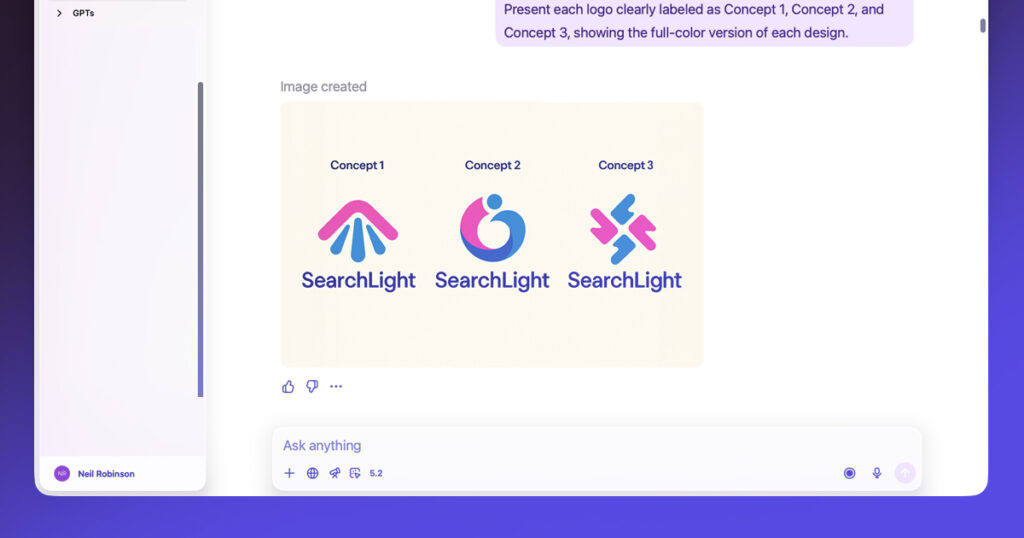
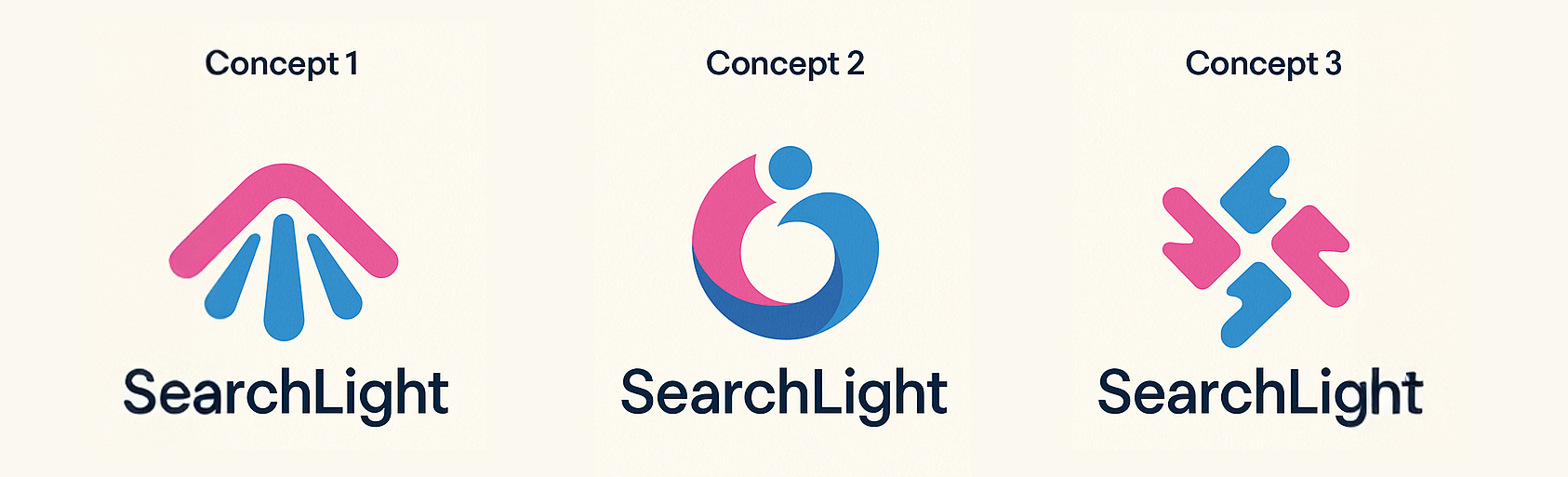
In the very early stages of my project for SearchLight Counselling and Therapy, I asked ChatGPT to give me three options for their new logo. I fed into the prompt all of my notes from the discovery call, with strong direction on what should and shouldn’t feature. I essentially gave it all of the information I was using myself in exploring options. It produced the three concepts below:
Are they any good?
Obviously not. They aren’t any good. Concept 1 looks like a rude emoji. Concept 2 is an unpleasantly rendered multiple swoosh and ball; it suffers from the same lack of meaning as almost all other swoosh logos. Concept 3 is the most nonsensical of them all; I really have no idea what it is meant to be or represent. Plus, it is veering ever so slightly into swastika territory, albeit filtered through a Disney lens.
So, no, there’s nothing here that could be considered worthwhile. These don’t really act as a viable stepping stone in the ideation process. Nothing is salvageable. As could be expected, I rejected them out of hand.
Why is this important?
Is this just a bit of navel gazing? Just an ego boost for designers who are feeling increasingly threatened by the encroaching pressure of AI replacement? That’s definitely a part of it. It’s certainly one motivational element of my own AI testing. It is also a useful display to clients about the importance of human creativity and ingenuity in building logos, identities and visuals that can express complex messages.
But there’s also an exploration here about what the future holds. AI is developing at an insane rate and without any sensible guardrails or regulation. It has exploded into social culture, and is talked about and played with by all demographics, in a way that no technological advance has since the advent of the internet over 30 years ago. The internet completely revolutionised modern life. It upended long-standing working methods, and destroyed conventions of consumption that had stood for decades. Centuries even.
AI looks like it will have just as broad and deep an effect on society. It looks like it may have an even more devastating impact on existing working norms. And at the forefront of that change are the creative sectors. It may be that in ten years, AI can more accurately replicate genuine human creativity. Until then, it bears repeating that AI is not an alternative to designers. It is a poor substitute, and the results are squirts, swooshes and swastikas.