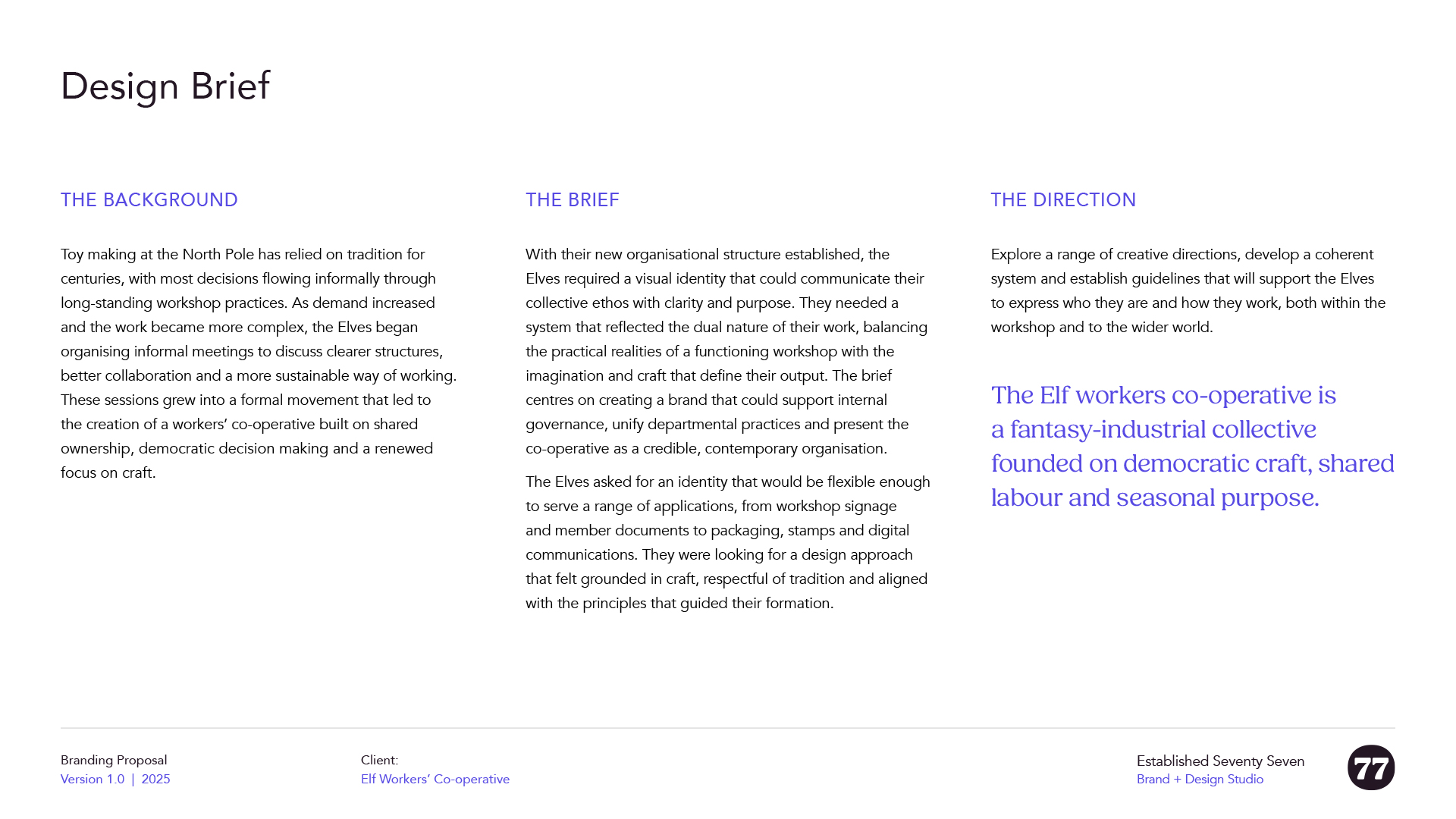

Many years ago, I came across The Brand Book for Santa by Quietroom. It was an excellent tongue-in-cheek branding exercise built around Santa Claus, treated with wry humour and over-the-top seriousness. That project stayed with me. Not just because it was a fun example of festive design, but also because it demonstrated how far you can take an idea when you commit to it properly.
Ever since, I’ve had it in the back of my mind to attempt something similar. A Christmas-themed brand, yes, but one that went beyond surface-level charm. Something rooted in folklore and mythology, with its own internal logic, visual language, and sense of purpose.
Why a fictional brand, and why now
Part of the appeal of taking on this fictional client was creative freedom. I wanted to work with humour, irreverence, and a slightly unusual premise, without having to dilute the idea to fit a real-world brief. Christmas folklore offers a rich visual and narrative palette, and I wanted to explore that fully.
More importantly, I wanted to challenge myself with an open brief (I’ve previously posted about the potential creative benefits of open briefs). No external stakeholders or predefined success criteria. No one else to refine the ask or steer the direction when things got uncomfortable. That meant defining the problem, setting the boundaries, and navigating the obstacles myself, in much the same way you often have to when a brief is vague or evolving.
In that sense, the project may be fictional, but the design challenge was very real.
What I wanted this to demonstrate
I wanted to show that even the most outlandish or unconventional idea can be handled with care, professionalism, and restraint. That you can apply the same thinking, structure, and discipline to a playful concept as you would to a corporate rebrand or a large-scale identity system.
I also wanted to allow a more light-hearted side of my personality to come through. Humour and irreverence play a genuine role in how I think about work, even when the output itself is serious. This felt like a rare opportunity to acknowledge that openly, without undermining the credibility of the work.
Defining success, partway through
When I started, success was quite narrowly defined. My original aim was to produce a complete set of brand guidelines that met my own expectations for clarity, consistency, and depth. I had an idea to draft up a website too as part of the project, but it was only intended as a small part, a potential ‘display case’ for the design work rather than the focus of it.
That changed as the project evolved. The website quickly became the primary vessel for showcasing the brand, not just visually, but conceptually. It forced decisions around tone of voice, hierarchy, content structure, and real-world application that a static guideline document alone would not have done. In hindsight, that shift was one of the most useful parts of the exercise.
The constraints that shaped everything
To keep the project grounded, I set several firm rules at the outset.
First, nothing overly festive or hokey. I wanted to avoid sparkles, fairy dust, and visual clichés. The world needed to feel functional and believable. Second, the socialist, co-operative nature of the organisation had to be foundational. This wouldn’t be just a decorative motif layered on top of the brand. It needed to influence language, structure, hierarchy, and values throughout the system. Third, no literal elves in the imagery. Elves could exist only as stylised, illustrative elements. This was about building an organisation and a culture, not creating characters.
Finally, the project had to be finished, live, and launched at least a week before Christmas Day. That deadline was non-negotiable, and it would later become one of the biggest pressures on the work.
What I was actively trying to avoid
More than anything, I wanted to avoid this feeling hollow. I did not want Elf Assembly to read as just a spoof or a novelty project. The humour needed to sit just below the surface. Ideally, someone could engage with the brand at face value, and only gradually realise the fiction when digging through the details.
If the project felt immediately throwaway, then I think that would have been a signal of failure. I wanted this to be something that could plausibly exist, even if it very obviously doesn’t.
So, with all of that in place, I put on my Christmas playlist, got out my sketchbook, and started drawing some elves…