
Over the last few years AI has moved from a curious novelty to ubiquitous necessity. Every sector is adopting it, sometimes willingly, sometimes reluctantly, and sometimes simply because everyone else is doing the same.
Alongside that rapid shift, there is a growing cultural fatigue with automated output that feels technically clever but emotionally hollow. You can see this tension clearly in the reaction to recent AI-generated campaigns. Many have been criticised for being off-key or lifeless (see Coke’s Xmas advert this year), while non-AI creative work seems to receive a disproportionate amount of praise simply because it feels real (see Apple TV’s new ident).
All of this has recently made me wonder: if AI automation becomes the default, could human-made work become a premium alternative? Could a company declaring itself “Human-Powered” or “AI-Free” trade on that as a mark of quality? In this period of continually improving generative models, with many people still in awe of the amazing ways in which AI can ease our lives, this idea may seem a bit silly (and not a little reactively grumpy). But, in time, could consumers seriously reach a point where they actively choose services that don’t rely on this latest technology trend? There is precedent for this kind of shift.
A familiar pattern
We have seen this pattern before. When technology pushes forward at speed and takes over a particular niche, a counter-movement often emerges that values the slower, more tactile, more human approach.
Film photography is a simple example. My daughters both take Polaroid-style cameras on holiday and, despite having phones that produce flawless images, they prefer the tiny printed squares that take time to develop and cannot be reviewed or shared instantly. The photos are worse, the process is slower, yet the experience feels more meaningful. This imperfection is part of the charm.
Vinyl records fit the same pattern. Streaming offers infinite convenience, yet vinyl sales continue to rise because listeners value the ritual, the warmth, and the physical connection to the music.
When a technology becomes dominant, there is often renewed appetite for the older alternative. Not because it does the job better, but because it has a comfort and familiarity that the new version is lacking. Nostalgia is a powerful feeling, and doing things the old way can often be preferable for consumers, even if it means paying more.
Could companies begin declaring themselves ‘AI-Free’?
If AI becomes embedded in every process, every output, every product, the decision to create something by hand or by human judgement could become a real differentiator. A point of pride and a statement of values.
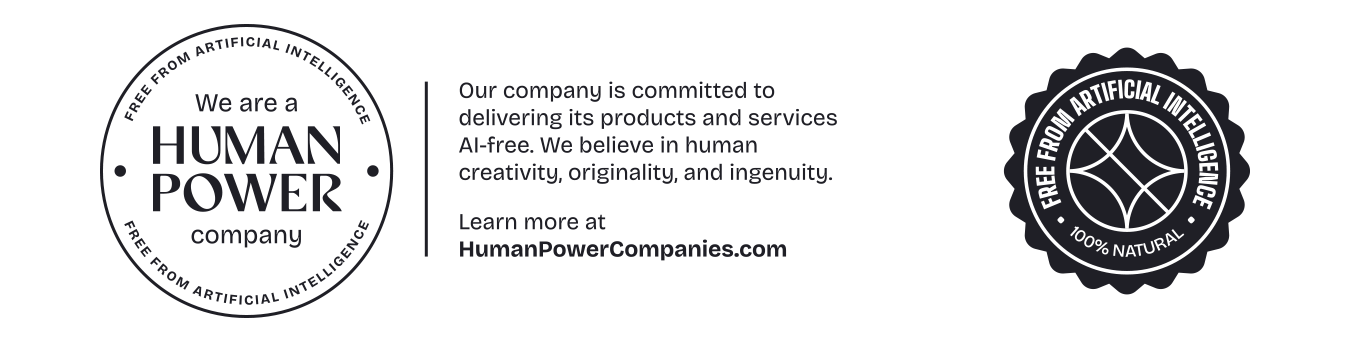
It might start as a playful label, a quiet rebellion against the onslaught of generative everything. But over time, it could become a genuine mark of authenticity, much like organic and vegan labels on food, Fairtrade certification, or small-batch indicators on drinks and handmade goods.
A company choosing to be human-powered is not anti-technology. It is signalling something else: an intentional decision to prioritise originality over efficiency and craft over convenience. And customers may well respond to that. Especially in a world where AI-generated output becomes so abundant that it begins to feel interchangeable.
The difficult part: can any company truly be AI-free?
There is one complication worth recognising. As AI becomes embedded within almost every tool we use, from design software to writing apps to the operating systems running our devices, it may be nearly impossible to prove that any process is genuinely free of it. Even if a business commits to human-led thinking and human-made execution, some degree of AI assistance will almost certainly exist in the background.
So any future “AI-Free” label would be about intention rather than purity. It would represent a focus on human judgement over automation and human craft over generative shortcuts. A company may not be able to guarantee that every tool it uses is untouched by AI, but it could commit to ensuring that the ideas and decisions, as well as the bulk of the ‘output’, come from people.
Human creativity as a premium experience
If AI continues to accelerate, it could be that a human-based service will become something you seek out because it carries a sense of personal involvement and accountability. A company stating that its work is entirely human-made might soon occupy the same space as a craft brewery, a film camera, or a vinyl album. A small but meaningful signal that something genuine has been put into the end product.
We’re not talking full-scale resistance. Simply a reminder that human ideas still matter. The question is no longer whether AI will change how companies operate; that is already an accepted reality. The question is where will real human craft fit into the picture, and could a byproduct of the rise of AI be the elevation of human-only output.
It may sound odd now, but the signs are already there. And if history is anything to go by, the appetite for the human alternative tends to grow precisely when the technological change becomes most impressive.
*No AI was harmed in the making of this blog post.